
Wishing you a wonderful holiday season 🎄
As we celebrate another year together, I want to express my heartfelt gratitude for your continued trust and support.
This holiday season, I'd like to stay connected and ensure I have your most current contact information. When you go to update your details, I invite you to choose a local Kamloops charity to support and I will donate $5 in your name.




A gift to the community
When you update your contact information, I'll make a $5 donation to the charity of your choice. Together, we can make a difference this holiday season.

Kamloops Food Bank
Supporting local families with nutritious food and essential resources throughout the year.

Kamloops SPCA
Providing care, shelter, and love to animals in need while finding them forever homes.

Royal Inland Hospital
Enhancing patient care and medical services for our community’s health and wellbeing.
2026 Housing Market Intelligence Report
A Multi-Source Analysis Grounded in Royal LePage, CMHC, BCREA, and the Bank of Canada With a Strategic Focus on Kamloops and of course me, David Lawrence
As we approach 2026, I wanted to go further than a surface snapshot of national and provincial conditions. I was genuinely excited to do a comparison among these different forecasting bodies to better understand how their viewpoints align, where they differ, and ultimately how the impact will look for us here in Kamloops. My goal is not merely to repeat forecasts, but to interpret them through the lens of our local reality so you can make informed decisions. I hope you find this comprehensive review both enlightening and valuable.
1. Royal LePage: 2026 as a Year of Market Reset
Royal LePage is, and has been for several years, one of the leading housing forecasters and economic voices in the country. Phil Soper, CEO of Royal LePage, is well respected across North America. I always look forward to hearing his perspective. He is down to earth, relatable, and able to translate complex economic trends into clear, actionable insights. His leadership is a major reason Royal LePage maintains a reputation for reliable forecasting.
Their 2026 national forecast calls for:
- ~1% national price growth
- ~2% growth for single-family homes
- ~2.5% decline for condos
- Significant regional variation including:
- Toronto approx. minus 4.5%
- Vancouver approx. minus 3.5%
- Montreal approx. plus 5%
- Quebec City approx. plus 12%
This is not a dramatic cycle. It is a grounding year and a recalibration after volatility. In my experience, these years often create the best opportunities for well-prepared buyers and sellers, especially in regions like Kamloops where affordability plays a stabilizing role.
2. CMHC: Structural Indicators, Forecast Accuracy, and What It Means for Kamloops
CMHC’s forecasts are not headline-driven. When I say their outlook focuses on structure rather than percentages, I mean that CMHC looks at the underlying conditions that create the market. They examine employment strength, construction capacity, rental vacancy patterns, household formation, migration, cost of borrowing, and supply pipelines. Instead of simply predicting a number, CMHC wants to understand whether the system is tightening, loosening, balancing, or shifting and why. Their 2026 lens points to gradual recovery, improving affordability, and slower housing starts.
Before we take their forecast at face value, it is worth reviewing how CMHC has performed over the past five years from 2019 through 2024.
Nationally, CMHC underestimated the pace of post-COVID recovery and the dramatic price escalation in 2021 and 2022. British Columbia often outperformed CMHC’s expectations in growth years. Interior BC, including Kamloops, consistently exceeded CMHC’s predicted price increases during strong cycles and softened more gently during downturns. Kamloops specifically saw stronger-than-expected price gains in 2020 through 2022, driven by affordability migration and extremely tight supply, two factors CMHC tends to undervalue.
CMHC’s current outlook highlights gradual improvement in the resale market, moderating housing starts due to financing constraints, ongoing affordability challenges in major urban cores, and renewed demand as interest rates stabilize. Their tone reinforces Royal LePage’s perspective. The year 2026 should feel steadier, more predictable, and structurally healthier.
3. BCREA: British Columbia Positioned to Outperform
BCREA is optimistic. It is their job to be positive, but their optimism is not baseless. It is derived from their economic modelling and decades of observing BC market behaviour. Their projections include:
- A 12.8% increase in MLS residential sales in 2026
- A 4% increase in the provincial average home price
- A more balanced provincial market as inventory normalizes
I am hopeful that the gains they are predicting do materialize. Historically, when BC experiences a rebound, Kamloops and the Interior tend to lead early because affordability and lifestyle factors draw buyers inland. If BCREA is correct, Kamloops stands to benefit.
4. The Bank of Canada: The Foundation Beneath Housing Forecasts
The Bank of Canada did not implement the late 2026 rate adjustment previously discussed. The Bank held the policy rate steady in December’s announcement, signalling a cautious approach heading into 2026.
Looking forward, the Bank of Canada anticipates a gradual easing of borrowing conditions, inflation remaining close to the 2 percent target, and no sharp increases in the policy rate unless unexpected economic shocks occur. Most economists expect the policy rate to settle within the 2.00 to 2.50 percent range during the 2026 calendar year, creating a foundation for stable borrowing and improved affordability.
5. Where All Forecast Bodies Agree
They collectively expect a more stable year, improved sales activity, modest but positive price growth, and higher performance in mid-sized and more affordable markets.
6. Where They Diverge
Rather than calling these contradictions, I see them as different vantage points pointing toward the same horizon. Royal LePage focuses on consumer behaviour. CMHC focuses on structural conditions. BCREA focuses on provincial economic momentum. The Bank of Canada focuses on policy guidance. Together, they describe a market regaining its footing with a shared direction.
7. Understanding 2025: A Three-Year Low That Sets the Stage for Renewal
The year 2025 marks a three-year low in activity. Higher borrowing costs, cautious builders, slow pre-sales, and buyer hesitation defined the year. In Kamloops, this slowdown was felt across all housing types, but especially in detached new construction. This cooling period resets expectations and reduces speculative excess. It steadies the market, clarifies pricing, and restores balance. These stabilizing periods often become the groundwork for healthier activity. According to all major forecasting bodies, this is exactly what is setting the stage for renewed confidence in 2026.
8. Kamloops Under the Lens
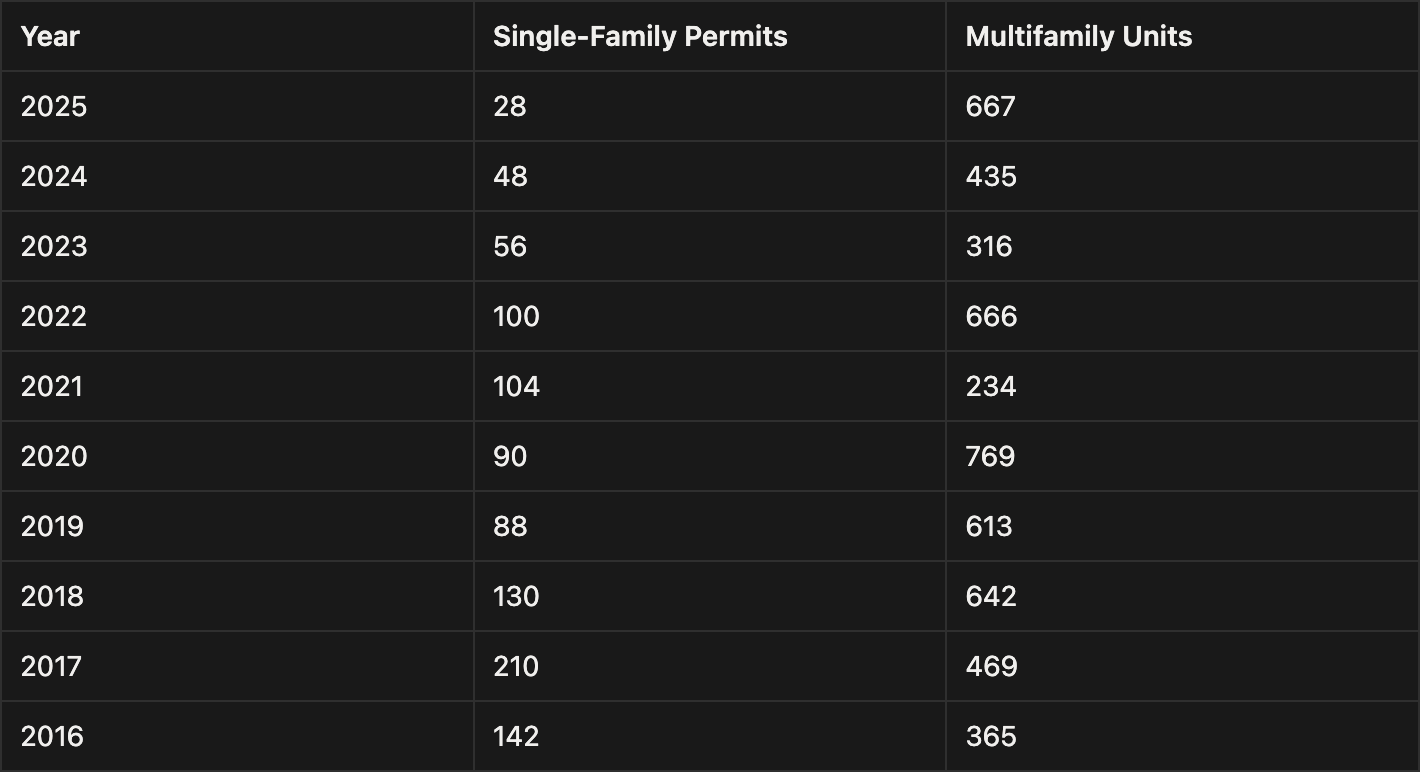
Kamloops is not Vancouver or Toronto. Our market behaves differently, both economically and psychologically. We are affordability-driven, lifestyle-driven, and supply-constrained. When inventory tightens here, the effects are magnified. Let us look at the historical building permit trends over the last ten years to better understand what is coming next.
8.1 Building Permit Summary for Kamloops 2016 to 2025
8.2 Let’s Break This Down
Single-Family Sector
The 2023 through 2025 period reflects a decade low in single-family construction. Builders have repeatedly faced rising construction costs, higher financing burdens, slower pre-sales, and increased approval delays. This contraction in new single-family supply will materially limit detached home availability in 2026.
Fewer new homes mean that existing inventory becomes more valuable, supply will not meet household formation or in-migration, and prices will experience upward pressure. A more competitive environment emerges, shifting market conditions closer to balance or even mild seller advantage. These supply shortages often mark the turning point in Kamloops cycles, particularly after quieter years.
Multifamily Sector
Multifamily development remains strong. The 667 units issued in 2025 exceed long-term averages. This mirrors BC’s broader shift toward density. While this supports balance in townhomes and condos, it does not replace the need for detached homes.
In addition, with this sharp uptick in multifamily construction, we are beginning to see early signs of downward pressure on rents throughout Kamloops. Rents have not fallen dramatically, as Kamloops remains a fundamentally strong rental market, but they have softened marginally in response to increased supply.
Based on the most recent CMHC Rental Market Report:
- Apartment vacancy rate in Kamloops is approximately 1.8 percent
- Purpose-built rental townhome vacancy is approximately 1.5 percent
- Single-family rental vacancy generally remains below 1 percent
These figures confirm that even with new inventory coming online, the market is still tight, though not as tight as in previous years.
Overall Implications for 2026
Detached supply is exceptionally tight. Multifamily supply remains steady but does not offset shortages. Demand is expected to improve as borrowing conditions stabilize. However, we will still likely see a softer market in apartment-style condominiums. The city has issued a significant number of multifamily permits, and although many upcoming projects are purpose-built rentals, they still contribute to gentle cooling in the apartment condominium segment.
What to look for: as this segment continues to adjust, it may present meaningful opportunities. If the Bank of Canada issues further rate reductions in the coming year, the apartment condominium market could become an attractive entry point for first-time investors seeking a stable, long-term asset. This is a worthwhile conversation for anyone considering investment real estate and evaluating whether now is the moment to act.
9. What 2026 Likely Holds for Kamloops
Kamloops is positioned for a rebound. A three-year slowdown combined with the tightest detached supply pipeline in a decade sets the stage. Price growth in the two to four percent range is reasonable. Sales activity will increase. Detached homes will outperform due to scarcity. The market pendulum should shift closer to balance, meaningfully improving conditions from 2023 through 2025.
10. Final Perspective
This report is the result of taking the time to compare several forecasting bodies and analyze what their findings mean for Kamloops homeowners, buyers, and investors. By studying Royal LePage, CMHC, BCREA, and the Bank of Canada alongside our local building data, we gain a meaningful picture of where the market is heading.
Kamloops enters 2026 structurally supply constrained, demand stable, and supported by a province expected to outperform national averages. These conditions collectively support a year of renewed confidence, modest appreciation, strengthened sales, and a healthier and more balanced housing environment.
Real estate is what I do, every single day, and it has been my professional world for more than 35 years. I have navigated clients through the quiet mid 90s, the turbulence of 2008, the limited supply years that followed, the aggressive conditions of 2018, and the unpredictability of the COVID market. I know this business. I understand how cycles behave, and I am committed to helping people make smart, confident decisions. I am prepared to assist in challenging markets where experience truly matters, and the same expertise applies in fast paced buying environments where timing and strategy can make all the difference. If you or someone you know is thinking about buying, selling, or simply exploring what is possible, I am here to help. Real estate is what I do. Call me.

Work Hard / Play Hard
This is a glimpse of my 2025. It's been one of the greatest years yet. I hope it was a great year for you as well. And I can't wait to see what 2026 brings for all of us.
Remember, real estate is what I do!